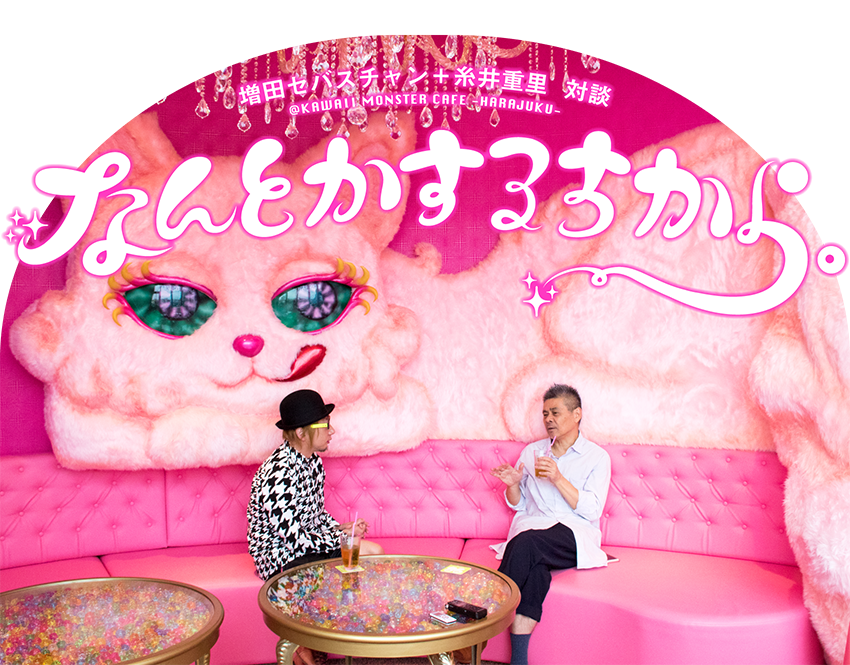
The Ability to Make It Work

Sebastian Masuda x Shigesato Itoi Interview
@KAWAII MONSTER CAFE -HARAJUKU-

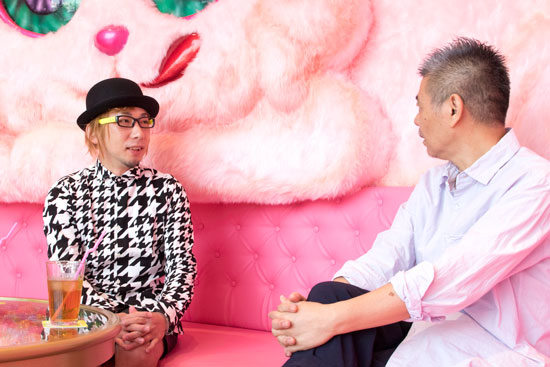
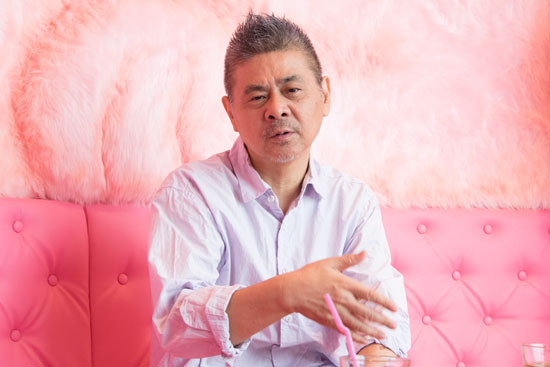
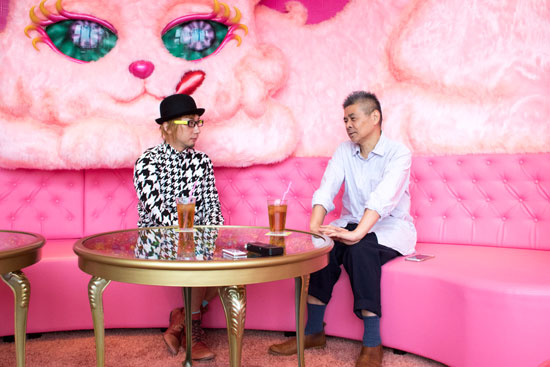
Art director Sebastian Masuda has created the Kawaii Monster Cafe, a place filled with mysteriously colorful food, bright interior decorations, and the same wild and cute style he developed for the early music videos of Kyary Pamyu Pamyu. Masuda’s unique style shines through the bright colors of his fascinating, unforgettable world. Shigesato Itoi sat down with Masuda after being intrigued by news of this new, exciting restaurant. At first glance, they seem like two men who have led very different lives, but their conversation uncovered a surprising commonality. It was wonderful to hear the way Masuda followed his passion to blaze a new trail.

About Sebastian Masuda
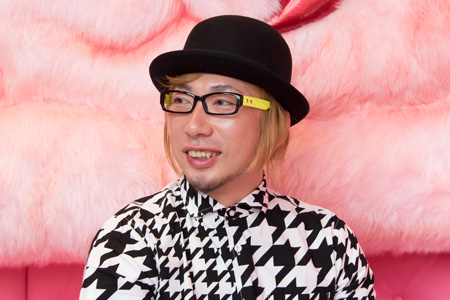
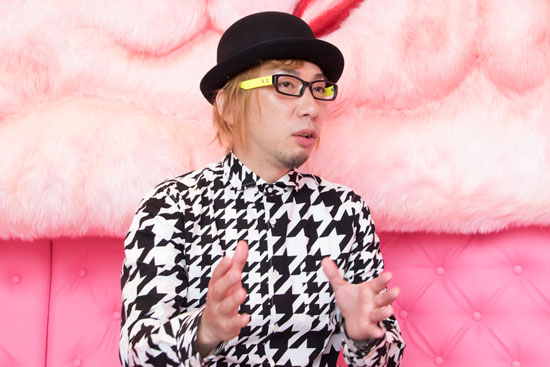
Sebastian Masuda is an art director/designer born 1970 who lead the “Kawaii” culture in Harajuku by pushing the boundaries with his designs in art, entertainment, and fashion. His main works include the 6%DOKIDOKI shop in Harajuku, art design for Kyary Pamyu Pamyu music video PONPONPON, production of theatrical restaurant Kawaii Monster Cafe in Harajuku, and more. He opened the art gallery Time After Time Capsule in 2016, hosted in Paris, London, San Francisco, and Los Angeles, and will host the gallery for the second time in New York in late October.

Sebastian Masuda Official Web Page

Part2

I can’t act like it never happened.

Masuda
(Enters back room) This is our secret room.
Itoi
Pretty nice secret you’ve got here. Boy, this is a really nice place.
Masuda
Really?
Itoi
Yeah. It’s nice to meet you, I’m Itoi. I’m glad we could meet.
Masuda
Wow, I’m so happy I got to meet you. I’ve been really excited about it. Thanks for coming today.
Itoi
I’m sure that whatever we talk about today, it’s going to be really interesting.
In fact it’s not often I get to meet people from such a different world than I.

Masuda
Oh really?
Itoi
It’s already quite unusual for me to come to the Kawaii Monster Cafe in the first place. I’m actually quite a lazy person, and I don’t concern myself with places that have newly opened or are really popular or well-known. But when I heard about this place, I just knew I had to come.
Masuda
I’m honored.
Itoi
I saw it somewhere on the news online, but I knew it wasn’t the kind of place I could come on my own. So at work one day I took some of my employees here, we met some of the Monster Girls, and took lots of pictures.
Masuda
I’m glad. Thank you so much.

Itoi
But when I actually came, something struck me as odd. This place has a fantasy theme, but it’s not a place that just takes the cuteness people expect, wraps it up nicely, and serves it on a platter. There’s something visceral about this place. Something premeditated about it, something clashing.
Masuda
Yes.
Itoi
I can see how it would take a lot of guts to put together a place like this. I’m sure it was an incredible amount of work that would be tempting to just drop halfway through. And I thought to myself, now that I’ve been here, I can’t just act like this never happened. So I found out that you were the one that put this place together, looked up your 6%DOKIDOKI shop, and bought a magazine about it. I also read your autobiography, Family Tree Cutter.
Masuda
Wow, you even read Family Tree Cutter? Thank you.
Itoi
The writing style is completely different, but it’s just like the hit book How to be BIG by Ei-chan (Eikichi Yazawa).

Masuda
You think so?
Itoi
Yeah. It’s written with the sense, “I haven’t reached the goal yet,” but it starts out with a refusal to stay in such a terrible place, travels through all kinds of interesting episodes, and arrives at where you’re at today. Although, it has been years since the book came out.
Masuda
Right. Family Tree Cutter actually came out before the 2011 disasters, and before I worked with Kyary Pamyu Pamyu.
Itoi
That’s why I’d like to talk to you today about what’s happened since the book came out.
Masuda
Thank you very much. I’m actually quite moved that I’m able to talk with you today. I, like many others, have been greatly influenced by the work you’ve done in the past. And I’ve chosen the path I’m on today because of my admiration for Shuji Terayama, so words are very important to me.
Itoi
Ah, I see.
Masuda
Actually, words are the most integral part when I think about all this cafe’s interior decoration. I designed this place with the concept of visually expressing the power of words.

Itoi
Ah, so it’s all about words. So that’s why you’ve done something so painstaking.
Masuda
Oh, you think? (laughs)
Itoi
If you’d started with the goal of visual entertainment, it’d be easy to build from that. But you can’t just move forward if you’re grounded with that foundation of words. Even if you called this place an “indescribable cafe,” that’s not going to make this place what it is. You’ve got to take responsibility by building it into an indescribable cafe one step at a time. And that’s a very strenuous job.
Masuda
It certainly is. But as difficult as it is, visualization is a means for me to express myself, so it’s very important to me. It’s that visual nature that allows me to transcend words and communicate my message to the world. So from that end, visualization is another form of words for me.
Itoi
I can see that clearly.
Masuda
It’s also fun to see when I complete one of these “visualization of words” and it actually surpasses my expectations. Honestly, it’s pretty boring when I make something and it turns out about how I was expecting. At the same time, I get bored when I’m at that point in the creation process where I’ve thoroughly built up an image in my mind. That’s why I prefer to work together with all kinds of people, have us make mistakes, and end up with a finished product that exceeds my expectations.
Itoi
I know exactly what you mean. I hate having an idea and bringing it to fruition as-is. When I make something, I prefer not to just press it in a mold. I’d rather sculpt the clay so it gradually takes on its shape, changing my mind as I go along. Even when I sit down to write, I go into it knowing only the most basic theme of what I’ll talk about.

Masuda
So when you write, do you just come up with it as you go along?
Itoi
I do, but it doesn’t actually go that smoothly. It’s more like I’m having an internal conversation with myself, asking what I want to write. That might be along the lines of what you were saying earlier when you create things. Even your autobiography. There are parts of it that suddenly turn poetic.
Masuda
I could have written the book in a normal style, but yes, there are parts that are suddenly written as poems.
Itoi
That’s one of the reasons I wanted to meet you. As I read your book, I felt we shared a similar way of thinking.
Masuda
When I first started writing Family Tree Cutter, I worked very closely with an editor as I went along. But halfway through, I just got into this high as I was writing, like something took over me.
Itoi
Yes, that seems to have happened to you. Like something appears out of nowhere and says “gimme the mic, I’ve gotta talk.”
Masuda
That’s a good way of putting it. That’s exactly how it felt.
Itoi
And there was one thing I was impressed by when reading your book. Many of the kids who are drawn to you have bad backgrounds, don’t they?
Masuda
Yeah, I think a lot of people have grown up still holding on to scars from their childhood.
Itoi
But I think you have a really healthy sense of distance with those children. You don’t say “I’m going to rescue you,” but instead take a completely frank approach. It takes a great deal of confidence to be able to do that.
Masuda
As I said in the book, it’s always felt that way. Like those are the kinds of people I find myself surrounded by. Most of the people who work for my 6%DOKIDOKI shop and the customers who come to this cafe are people who harbor scars like that. It’s not that I’m trying to attract that kind of person, nor do I want to be a public figure trying to change the world. I just naturally attract people like that. It’s been that way my whole life, so at this point I’ve come to realize that I’m the one being supported by these kids.
Itoi
That almost reminds me of Nausicaä, when she gets carried by the Ohm.
Masuda
That’s true, I can see it being a little Nausicaä-esque.

2016-12-06-Tue

BACK | Part 1