The Ability to Make It Work

Sebastian Masuda x Shigesato Itoi Interview
@KAWAII MONSTER CAFE -HARAJUKU-

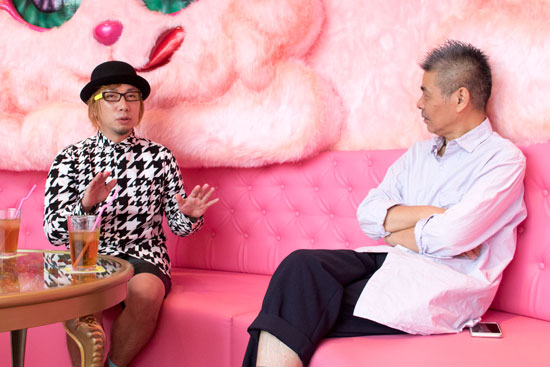
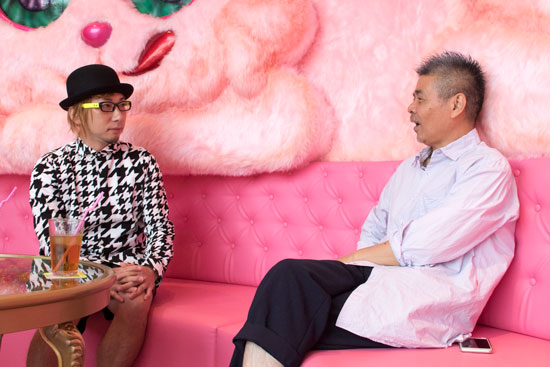
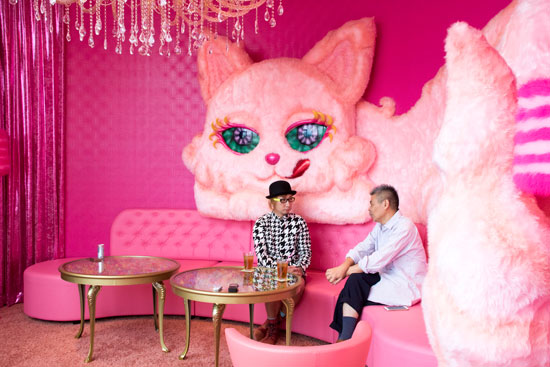
Art director Sebastian Masuda has created the Kawaii Monster Cafe, a place filled with mysteriously colorful food, bright interior decorations, and the same wild and cute style he developed for the early music videos of Kyary Pamyu Pamyu. Masuda’s unique style shines through the bright colors of his fascinating, unforgettable world. Shigesato Itoi sat down with Masuda after being intrigued by news of this new, exciting restaurant. At first glance, they seem like two men who have led very different lives, but their conversation uncovered a surprising commonality. It was wonderful to hear the way Masuda followed his passion to blaze a new trail.

About Sebastian Masuda

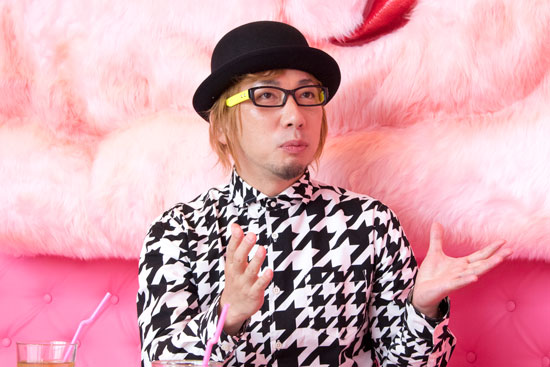
Sebastian Masuda is an art director/designer born 1970 who lead the “Kawaii” culture in Harajuku by pushing the boundaries with his designs in art, entertainment, and fashion. His main works include the 6%DOKIDOKI shop in Harajuku, art design for Kyary Pamyu Pamyu music video PONPONPON, production of theatrical restaurant Kawaii Monster Cafe in Harajuku, and more. He opened the art gallery Time After Time Capsule in 2016, hosted in Paris, London, San Francisco, and Los Angeles, and will host the gallery for the second time in New York in late October.

Sebastian Masuda Official Web Page

Part5

What is “Main Culture?”

Itoi
I can see the Kawaii Monster Cafe is actually a theater in restaurant form.
Masuda
Oh, you noticed? That was fast. Yes, actually, I wanted to create this place in a way that would make people realize months from now that it was just like Shuji Terayama’s Tenjo Sajiki [theater troupe from the 60’s-80’s].

Itoi
Yes, I was amazed.
Masuda
Back when the project first started, this 7,100 square-foot (660 square meter) building was completely empty. I think it’d been vacant for a good year or so. It’s a nice location, but maybe it was just unsuitable for other companies. That’s when the owner, DiamondDining, told me I could do whatever I wanted with the place.
Itoi
I see.
Masuda
But since they have their own way of doing things as a company, usually they receive a blueprint of the interior and everything. But I had a feeling they’d have a lot to say about everything if I gave them all the details as we went along, so I just apologized for not having the blueprint ready yet and went along with construction. I never ended up showing them a thing until the place was completely ready, so I’m surprised they let me get away with it.
Itoi
Well, in their case, they’d hired you as a person, and not a specific project, so I’d think it’s fine. And DiamondDining is known for their fascinating projects, so I think it was a perfect fit.
Masuda
I really am shocked though, that they let me make everything my way.
Itoi
It must have cost a ton of money.
Masuda
Well, yeah, it did. (laughs) I at least have more experience than most people, so I was able to keep costs down more than usual.
Itoi
Oh, that’s good.
Masuda
Of course, it costed much more than a normal restaurant. But I’ve worked part-time at an interior decoration company when I was in a theater group with very little money, so I tested out all kinds of tricks and knew I’d be able to use them again in the future someday. So that’s just the kind of thing I know how to work around, and it ended up costing less than everyone would think.

Itoi
So that would make this a DiamondDining shop, and you the art director.
Masuda
That’s right. Although I was more of an advisor when it came to choosing the food menu and naming the menu items.
Itoi
Does this cafe take up the majority of what you’re working on lately?
Masuda
Among my self-expression entertainment projects in Japan, this is my main one. But internationally, I mainly work as an artist, and most of my self-expression is through the art galleries and such that I hold outside of Japan. But at its core, the Kawaii Monster Cafe project is a part of that. I tend to utilize a strong sense of storytelling alongside popular culture in a way that someone would utilize rock and folk sounds together.
Itoi
And so you’ve got those two parts of you: one that knows how you want to express yourself, and one that inherently understands that you need to be able to support yourself financially.
Masuda
Yes, that’s true.
Itoi
I’m sure your views on money have been a help along the way. As I read your autobiography, it seems you’ve spent money rather wastefully since you’ve been young, and tend to be fairly unimpressed with it. So in a way, you’re able to treat money with less respect than others do.
Masuda
Perhaps.
Itoi
And at the same time, you’re aware that everything you do is severely limited without money, and appreciate its importance.
Masuda
When I was about twenty years old, people in my theater group and fellow contemporary artists used to tell me I was obsessed with going mainstream. I didn’t know what was so bad about it, though.

Itoi
It’s definitely the kind of thinking you’d get from a student—that insistence on seeing everything split into two clearly different directions, with mainstream being the inferior between the two. Nothing’s that simple, and I’m sure that bias of treating mainstream things negatively remains to this day.
Masuda
Come to think of it, I’m involved in several international projects, and I’m not limited to Harajuku. Some people in Harajuku imply somewhat negatively that I’ve changed.
Itoi
So it’s kind of like saying, “Not to trash-talk my own friend, but…” Jun Miura actually hears the same thing from people, so maybe you guys are alike.
Masuda
I wonder.
Itoi
He doesn’t look at things as major versus minor, or subculture versus mainstream. If anything, he absolutely insists that his work is mainstream and not subculture. (laughs) Perhaps you’re the same in thinking those will turn around.

Masuda
In the 90’s, Harajuku was seen as more of a place for men, with styles of NIGO and UNDERCOVER, for example. But in reality, our girly culture already existed on the outskirts of that, with people like Tomoe Shinohara. But that was before blogs, so our culture was basically swept under the rug against our will. It was a hard pill to swallow while I was still working so hard back then.
Itoi
So even though a part of the culture was being supported by girls, there were no girls written into Harajuku’s chronology.
Masuda
That’s right, even though we were always there. But in turn, now our colorful sense of fashion has come to completely overtake what the term Harajuku Fashion means.
Itoi
Oh, yeah?
Masuda
Yeah. So while we may have been part of subculture back then, now we’re referred to as mainstream. I never dreamed that we’d actually be leading the way in mainstream culture, so it’s a little confusing to have that switch flipped on us all of a sudden.
Itoi
Well, even though people refer to you as mainstream, I’m sure you’re still only halfway through your journey. If you’re past that and reach further toward where you truly want to be, don’t you think you’d start feeling comfortable passing off your position to other people?
Masuda
Perhaps.
Itoi
Plus, I’m sure you’ll be an incredibly strong person as you go along, with the way you’ve always worked as part of a team. I’d always done things completely on my own growing up, and it wasn’t until I was your age that I started realizing it was important for me to work as part of a team. It was incredibly difficult learning how to work with others that late.

Masuda
Well, to tell you the truth, I’m only really able to bring myself to talk about this today because it’s with you, but I’m not actually very good at working with others. Even my cell phone is pretty empty; I can’t have more than 40 entries in there total.
Itoi
So you’ve only worked well with others out of necessity.
Masuda
I guess… Well, I’ve actually never really worked on anything on my own before.
Itoi
Maybe that’s from your history working with the theater group. That’s the last place you’ll find anything you can work on by yourself.
Masuda
That’s true. I entered the group in 1990, when we would all go to a cheap coffee shop and drink coffee while discussing theater until the sun rose. When I was 19 or 20, I couldn’t stand it, but as I got older it became quite useful.
Itoi
Perhaps it enriches us when we cope with such barren situations without totally integrating into them.
Masuda
Maybe that’s it.

2016-12-06-Tue

BACK | Part 4