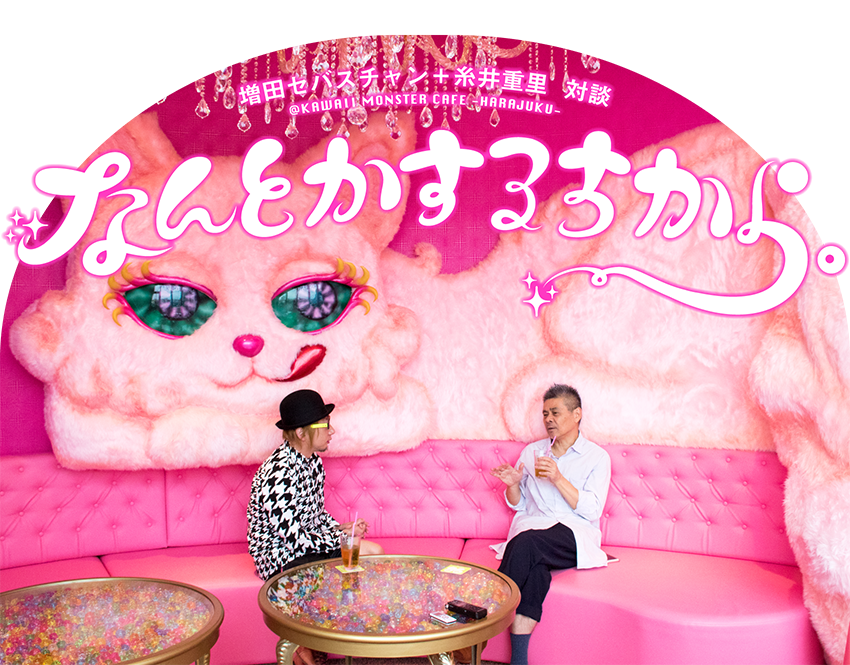
The Ability to Make It Work

Sebastian Masuda x Shigesato Itoi Interview
@KAWAII MONSTER CAFE -HARAJUKU-

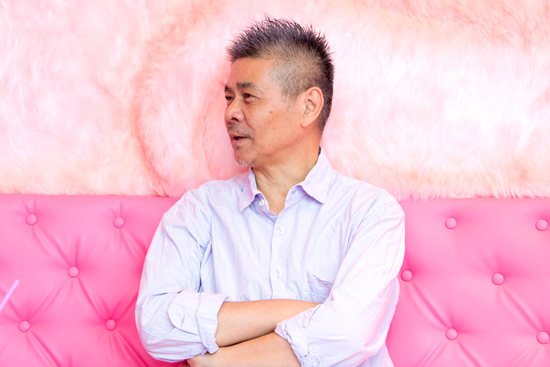
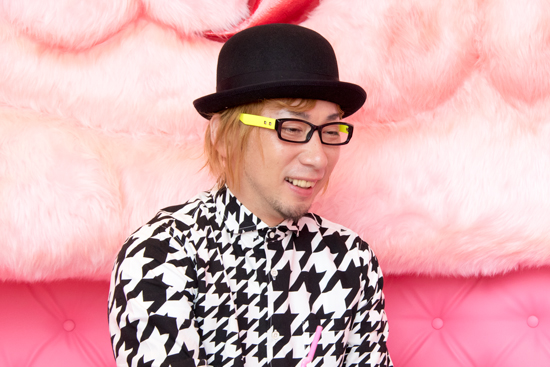
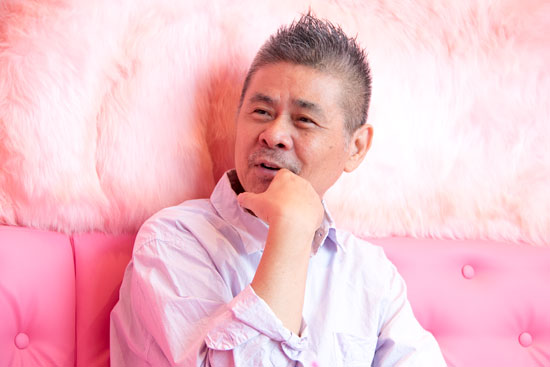
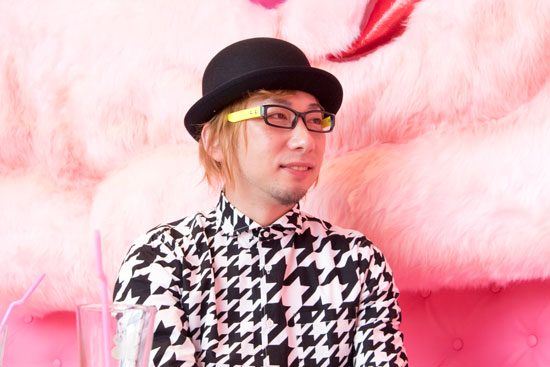
Art director Sebastian Masuda has created the Kawaii Monster Cafe, a place filled with mysteriously colorful food, bright interior decorations, and the same wild and cute style he developed for the early music videos of Kyary Pamyu Pamyu. Masuda’s unique style shines through the bright colors of his fascinating, unforgettable world. Shigesato Itoi sat down with Masuda after being intrigued by news of this new, exciting restaurant. At first glance, they seem like two men who have led very different lives, but their conversation uncovered a surprising commonality. It was wonderful to hear the way Masuda followed his passion to blaze a new trail.

About Sebastian Masuda
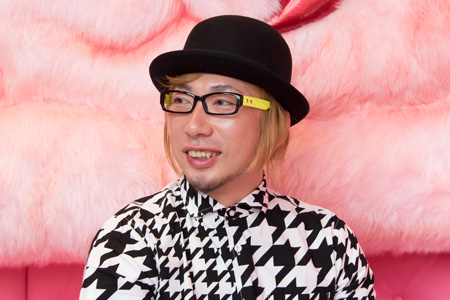
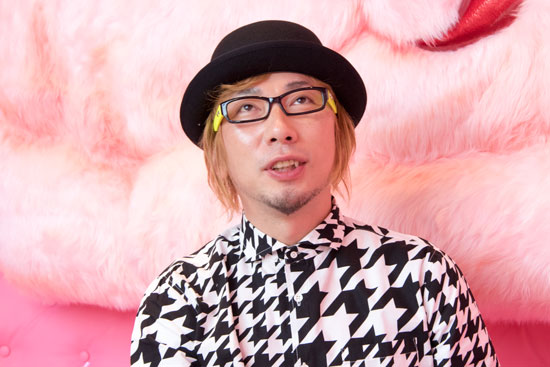
Sebastian Masuda is an art director/designer born 1970 who lead the “Kawaii” culture in Harajuku by pushing the boundaries with his designs in art, entertainment, and fashion. His main works include the 6%DOKIDOKI shop in Harajuku, art design for Kyary Pamyu Pamyu music video PONPONPON, production of theatrical restaurant Kawaii Monster Cafe in Harajuku, and more. He opened the art gallery Time After Time Capsule in 2016, hosted in Paris, London, San Francisco, and Los Angeles, and will host the gallery for the second time in New York in late October.
Sebastian Masuda Official Web Page

Part7

The ability to make it work.

Itoi
There’s something wonderfully defiant about this place. Like a healthy sense of ambition that came in from out of town.
Masuda
I can see that. (laughs) I’m 45 now and originally from Matsudo City in Chiba Prefecture. Back when I was in my teens in the 80’s, I would travel to Harajuku on the Chiyoda subway line and watch the Takenoko-zoku street dance group. There was so much in Harajuku that influenced me during those impressionable years of my life. I was sort of a wannabe rebel that didn’t quite have it in me to fill the role, but there were plenty of wannabes like me in Harajuku. Never in my life did I foresee myself ending up in Harajuku working on the projects I’ve got now.
Itoi
There are all kinds of rebels, but the ones I admire don’t pretend to be working to make the world a better place. They say, “I’m just here to protect me and you.” Eikichi Yazawa is cool in the same way. He always puts himself in the subject of his sentences: “I want money.” “I want good booze.” “I want a nice car.” Although afterwards he explains that he doesn’t mean it literally. I think the test of a rebel is whether they have that spirit of the self.
Masuda
Then yeah, I guess I was a wannabe rebel myself.

Itoi
Then that means you would understand both sides. If you were a wannabe rebel, then I was a wannabe student. I went to college, but I idolized rebels. College people don’t center the conversation around themselves.
Masuda
So we’re same in that we’re both wannabes.
Itoi
We are. I was greatly influenced by Yazawa myself. I am still now, and it’s Yazawa that I go to when it matters most.
Masuda
I know you were the one who interviewed Yazawa for his autobiography. I was extremely moved when I read it.
Itoi
Yeah, you must have read it.
Masuda
I did.
Itoi
All rebels and rebels-in-training read that book when it came out. People who worked at restaurants also read it. In other words, people who believed they could make it to the top through hard work read that book.
Masuda
I was really influenced by it. I even read the graphic novel based on it.
Itoi
I’m a baseball fan. When a game reaches its climax I put on my headphones, mute the TV, and listen to Yazawa’s music, so that whatever happens, I’m not disappointed.

Masuda
That’s amazing.
Itoi
I don’t want to rely too much on his music for personal reasons. I have to take care of myself and should instead be ready to give something to Yazawa. But because I have no control over baseball, I get disappointed. That’s why I listen to Yazawa. Yesterday, I was listening to Yazawa on the train on my way to the Swallows game.
Masuda
So that’s how you stay encouraged? That’s interesting. I see there’s a lot of ways to go about it. I’d just assumed that you’d found some way to switch those feelings on and off.
Itoi
I haven’t. It’s no different from when I was a kid.
Masuda
(Laughs) I’m glad to hear that.

Itoi
The older I get, the more I appreciate Yazawa.
Masuda
I know what you mean. I imagined you as more of a cool, collected observer. I was always hurrying to reach that more detached world you were in, but I felt very far away from it.
Itoi
No, not at all. If you suppress your own feelings, the things you do become meaningless. Of course you need to be cool and collected to make it, and to create more interesting things. But if you don’t have that part of you that fills up with emotion, there’s no reason to live. You need that passion.
Masuda
Oh, I’m so happy to hear that. I was never able to see that part of you from where I stood.
Itoi
Oh, you couldn’t?
Masuda
No.
Itoi
I see. Then I guess I should keep talking. After all, I only became collected after recognizing the need for it, and working to develop it.
Masuda
I had a complex about being from Matsudo City, with its reputation as the bad side of town.
Itoi
Having a complex is important.
Masuda
I never went to college, either. I was just a weed that sprung up there. I had never worked for advertising agencies. I’ve always kind of sneaked into things.
Itoi
I’m the same way. The first company I worked at was in Harajuku. At the time, the only thing available at Harajuku advertising agencies was contract work. I would get pictures that photographers and art directors had thrown together with the expectation that, somehow, I would turn them into an ad. Of course an ad is more than just images. It was that need to make it work no matter what that brought me my first success.
Masuda
I wonder if editorial skills are the key.
Itoi
I think it’s more the ability to make things work.

Masuda
That’s true.
Itoi
You used that ability when you went on your trip to Europe.
Masuda
It’s really necessary for survival.
Itoi
It’s what connects you with your next interesting opportunity. For me, it was the chance to work together with musicians and work on projects outside of copywriting.
Masuda
Yes, that’s how it goes in the beginning.
Itoi
Before I worked on Yazawa’s autobiography, I was hoping to interview Down Town Boogie Woogie Band. Because I had no way to get in touch with them, I looked up their schedule, saw that they were playing a show in Okinawa, and went to see it. I asked around to find out where they were staying and booked a room there, and then I asked the front desk if they would leave a note for the band. The note said, “Can I interview you? I’m a writer for Rolling Stone.”

I was waiting in my room, with no idea what would happen next, when the singer showed up. And that’s how I got my break. I paid for the whole thing out of pocket, but I knew it was what I wanted to do.

Masuda
I see.
Itoi
An editor at Shogakukan saw my work and asked me to write Eikichi Yazawa’s autobiography. This was all happening while I was working in Harajuku. I don’t know for sure, but that trip had probably cleaned out my bank account.
Masuda
That’s how it still is for me.

2016-12-06-Tue

BACK | Part 6